buttoned up and affecting bohemian ways
My mother had nine brothers and sisters and my father had seventeen! I had about fifty aunts and uncles and long ago lost count of cousins. I was born in 1946 near Milwaukee, Wisconsin. Shortly before she passed away, my mother showed me a drawing I made at age four – an alarm clock with primitive three-point perspective. Maybe art was in my DNA or perhaps it was just hand-eye coordination. One of my grandfathers was a commercial artist and there were always several musical groups comprised of members from both sides of the extended family.
For me, art was all-consuming. In woodshop, a plank-joining lesson became a palette-shaped drawing board. I still use it regularly to sketch painting prelims. I was a loner teen who spent more time drawing in his room than out in the teenage world. As other kids feverishly anticipated their first car, the spectacle of my grease-coated male cousins lost in the rapture of jalopy-wrenching convinced me to steer toward a less-traveled detour. How odd was I? You decide. I've never driven an automobile.
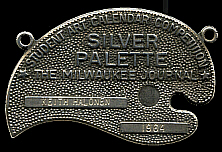
societal praise
In 1963, an uncle purchased a drawing from me, a pivotal experience. The next year I entered a scholastic calendar contest sponsored by the Milwaukee Journal. I earned an award and one of my paintings found its way into the calendar. Yet another seminal incident sealed my fate. A reporter asked to purchase one of my other submissions, my first oil painting on Masonite panel. It was a small, realistic picture of simple wood chess pieces.
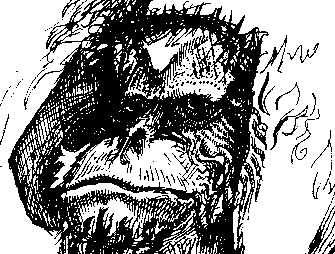
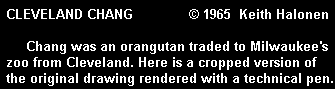
I couldn't get enough school. I was invited to attend Saturday morning workshops at the Milwaukee Art Museum, where endless art supplies kept me busy as I tried the nerves of my teachers. From his factory job, my father brought home catalogs of old mimeographed requisition forms. They were blank white on the backside and I spent a dozen or more sheets daily. I carried a sketchbook everywhere, even to the zoo.
After graduation, I held many jobs. I was a farmhand and my boss said I should be a professional artist. At a record distribution firm, I acquired esoteric musical tastes while in charge of returns that overstayed their welcome on store shelves. The owner said I should be illustrating album covers. I worked construction for the city of Milwaukee. The engineers told me I was in the wrong line of work. I cut material in a plastics factory. My supervisor told me I was wasting my time there. I yawned through graveyard shift in a radiator factory. Coworkers looked over my shoulder during breaks and asked why I wasn't doing art for a living. Is it any wonder I began to consider the idea?
I took advantage of the daylight hours by painting and drawing. I began to suspect that I really might be wasting my time with punch presses and deafening metal saws. In 1966, I moved to California and worked in a department store print shop. I did seasonal work at the Post Office. Fellow employees often said I could be "doing better."
During the late 60s I began to sell original drawings and landed some book illustration and poster contracts. I did a drawing for Rolling Stone and illustrated several pages in elementary school textbooks produced by the Harcourt Brace Jovanovich Center for the Study of Instruction. I had two one-man shows in San Francisco. I sold nothing and so it was all too easy to make the leap into commercial work. Easy is truly the most apt word to describe this lateral move. My graphics career literally materialized in the form of offers to hire me. The money made proceeds from selling my drawings seem meager. How could I turn it down?
In retrospect, it was not so good an idea as it seemed at the time. Almost immediately, things began to get complicated. And to be honest, they never stopped getting ever more complicated as my new career flowed along its course with deceptive naturalness, like a river cascading from mountain springs of cash to an imagined ocean of affluence. It's true I enjoy complexity in my art but by contrast, I definitely favor simplicity in my life. I began to distinguish different categories of art. None are bad per se, but it became obvious many artists' temperments are better suited to commercial graphics than mine. Money has a way of blinding us to other perhaps more valuable values. I was as blinded as an artist can be.
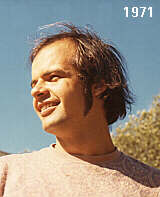
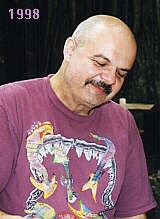
a youthful Jack
Nicholson ringer?
We're creatures of habit and the work we do for our livelihoods is self-reinforcing habit. If earning money in exchange for selling one's services becomes easy, it also becomes highly addictive. It creates a false sense of popularity. Without being consciously aware of the not-so-gradual transition, I moved from being personally creative to serving only the commercial needs of others. I became the poster boy for the business-phobic artist archetype. I almost never produced art from my own inspirations, for my own satisfaction. I spent two decades and then some sublimating my personal creativity. From my origins as an odd loner teen, I had progressively subjugated my skills and ignored my personal artistic development. As a pen for hire, everyone but me had purposeful plans for my talents. I was addicted to graphics. And why so? Because it was easy. Because it paid off. Because it had become habitual.
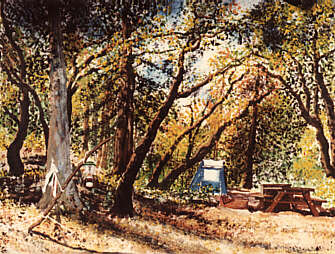
BULLFROG POND © 1977
a rare watercolor created while camping
in Armstrong Woods – Guerneville, California
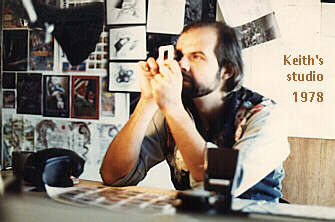
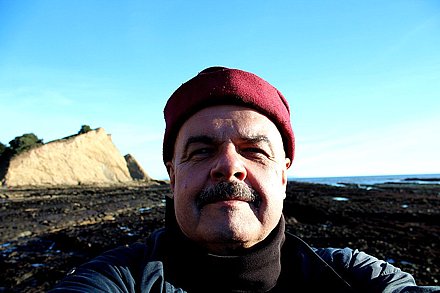
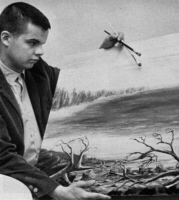
making a career out of something he loved
till he made a career out of it
Whatever constitutes addiction, there's no denying the hold it has on its host. From the early 70s through the mid-80s, I produced precious few personal works and deadline pressures took a predictable toll. The whole business of my business stacked up and loomed over me like the deck of cards towering over Alice in an increasingly tense Wonderland. Something had to give. A close friend requested an oil portrait and in my spare time I began painting again after almost 20 years of ignoring myself. Just handling oil media after such a lengthy separation was inspiring but it would be yet another ten years before I'd recognize the very real need to devote myself exclusively to my own art. If my art would not support me, the only recourse was for me to somehow support it.
Rehab is painful. Gnashing teeth and disturbed sleep were aggravated by the strong social leverage of clients who wheedled, bribed, and predicted dire repercussions were I to abandon my graphics career. And they weren't too far off, of course, since they stopped giving me money when I stopped working for them. Their disinterest in my self-interest was readily understandable to me. But my reluctance to further serve their self-interest was utterly unthinkable to them. Certainly I was my own worst enabler.
After all, in our society the bottom line is the bottom line. Do any little thing even slightly well and you will be urged to turn it into a business. The notion of a deliberate choice that might make one poorer for a hope of being happier is an incomprehensible paradox in a culture where money is the only goal considered to be worthwhile. My value to my clients was predicated on the willing subservience inherent in my station as an independent artist providing affordable quality graphics matched only by corporate agencies with high overhead and astronomical mark-ups. The short of it was, my skills increased their profits. Too bad the trade-off was that I felt so drained and diminished by the experience.
I can't fault artists who enjoy commercial graphics work. There's no shame in selling one's skills. But I felt bereft there. I don't malign artists who target a popular market, like painting grape fields in wine country or kittens playing with yarn. Who would shy away from a spiggot spouting money? But I just can't do it. I can't rework the same subject matter incessantly. Bless cartoonists but if I had to draw a charming character over and over and over, I'd suffer chronic depression. It's not who I am and that's all there is to it. I'm unequal to such demanding tasks. I need to work in a more forgiving, more personal milieu.
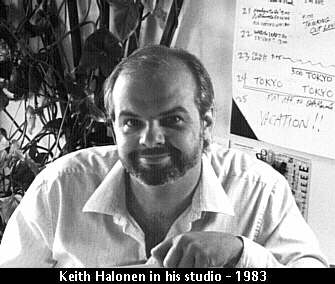
I have nothing against money. The often misquoted Timothy actually said, "The love of money is the root of all evil." The prices of my oils are not based on the time it took to paint them. Other more pertinent factors determine their valuation. If no one else agrees with the value I imbue into my art, too bad for me. But I can't view money as the goal. I see it only as a tool of little use until we part with it. I juggled too many hats for too long. Pursuing ever increasing income by taking on ever increasing responsibility broke me. I don't need to be on the wrong side of a complicated one-sided business construct to screw myself royally. I can do that without any help at all from the outside world.
So when the financial shit finally hit the esthetic fan, it became a more intriguing prospect to see how little it might take to get by instead of how much. If we trade our time for money, may we not sacrifice our money for time? Furthermore, I feel impelled to produce only my own personal ideas. In fact, the surest way to guarantee I will not paint a certain subject is to suggest it to me. The most important word I have learned in life is the word No. My graphics business was already severely in decline when I began reclaiming productive time for my own fine art aspirations. My commercial career had imploded to the point where it was a foregone conclusion I would never recover my losses. I've made significantly less money during each successive year since but I've also returned to some relatively modest pursuits that gave me much pleasure earlier in life.
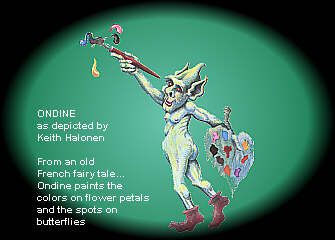
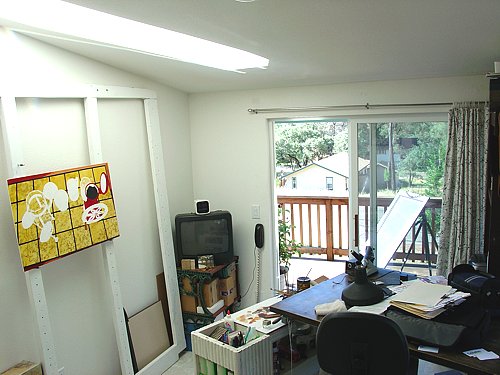
To treat residual effects of an old impact accident, I engineered my own free weights exercise therapies. I also began studying chess again, even returning to occasional tournament competition. Turns out as rated players go, I'm smack in the center of the bell curve. But I don't mind losing while playing such a beautiful game. Despite my truncated income, I reinvented myself as a much more focused artist. I live a deliberately simple life at an unforced pace. I garden year round. Art supplies for painting are affordable compared to expenses involved in producing commercial graphics. I have tubes of oil paint that are twenty years old. I know how to revive them. I've found them at garage sales, flea markets, and church bazaars. And my wafer-thin layered glazing technique uses very little pigment to produce sensationally colorful results.
I'm doing the best work of my life. All it requires is a willingness to endure and persist. Ars gratia artis. How odd am I? I've never driven a car. I've never had a credit card. I have several computers but I don't have a cellphone. I don't need 215 "friends" I've never met – the several flesh-and-blood friends who remain dear to me are sufficient. I'm not giddy with delight and I could certainly be "doing better," but to feel so much more positively about myself than I did in the past is not something I can dismiss with cavalier nonchalance.
The 80s saw the popularization of computer graphics programs. They improved rapidly and decimated what was left of my client base. Clients began jumping ship faster than I could throw them overboard! I admit I was tempted to try my hand at digital art but once I actually had a computer, I discovered I didn't care for doing graphics on it. I can't collaborate with other artists in an agency setting, either. I suppose a psychologist might suggest therapy so I can better fit into the society in which I live, but I haven't enough money to afford psychological counseling and wouldn't spend any on it if I had. Also, I'm skeptical about the notion that I need some adjustment more than my ambient social culture needs adjustment.
Perhaps another psychologist from a different school of thought might argue that I'm actually doing the healthiest thing to improve my society – engaging in right livelihood – even if there's very little livelihood to it. Pushing buttons is OK and proper for those who truly enjoy it but speaking only for myself, I desperately need to physically handle real media. I need to smudge crayon, crumble erasers, smear paint. And I need to do that all by my lonesome, in my art studio. I feel now more than ever before that I'm doing the best thing for the entire world when I'm doing the thing that makes me feel best about myself.