
 GALLERIES —


|
GALLERIES —
|
|
|
|
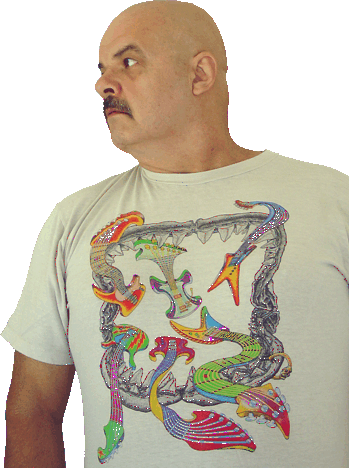
MODEL T Keith wears some of his own art
|
|
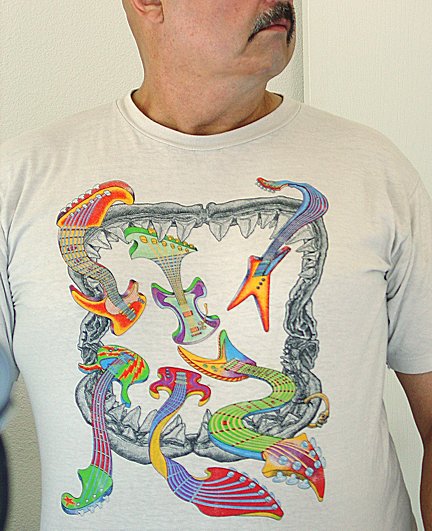
This T sports one of my favorite designs created for my friend Al Hartman from EarthWings. It's one of my favorites because I contributed to the concept. Eel-lectric guitars swimming through a Megalodon shark jaw. Yeah! |
|
|
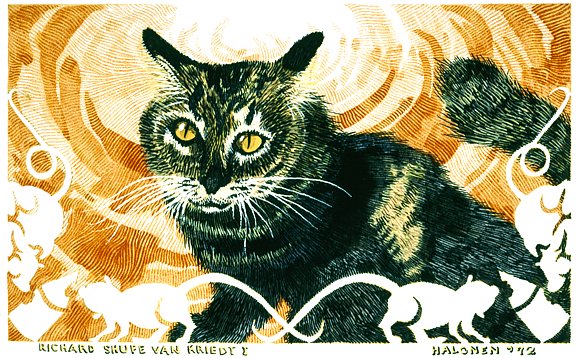
The general consensus places these giant sharks in the Cenozoic Era from 28 to 1.5 million years ago. Megalodon's jawbones were 6 feet (183 cm) on the horizontal between hinges. It would have been capable of swallowing a human being whole. I've been entertaining the thought of adding wings to this website for some of my digital art and a selection of original ink drawings from the 60s through the 80s. Even though I can't resell commercial illustration reproduction rights that conflict with the original clients', I have always contractually reserved all non-conflicting rights of reproduction and full control of the originals. I can hear the wheels turning in my own head! Here's a commissioned animal portrait and a trade illustration. |
|
|
RICHARD SHUPE VAN KRIEDT I © 1972 © 2000 Keith Halonen
color ink portrait for Dagne Van Kriedt San Francisco, California |
|
|
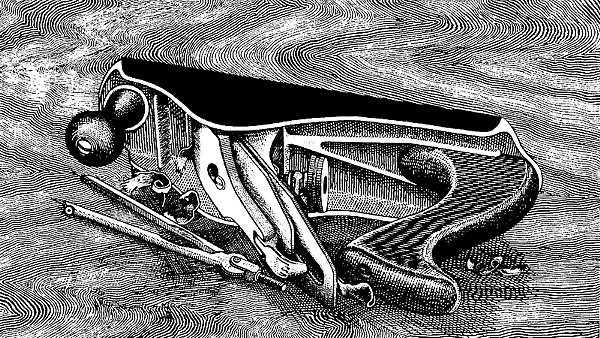
PLANE © 1983 Keith Halonen
ink illustration for joiner Dave Lee Guerneville, California |
|
done just for the sake of the doing... |
 |
|
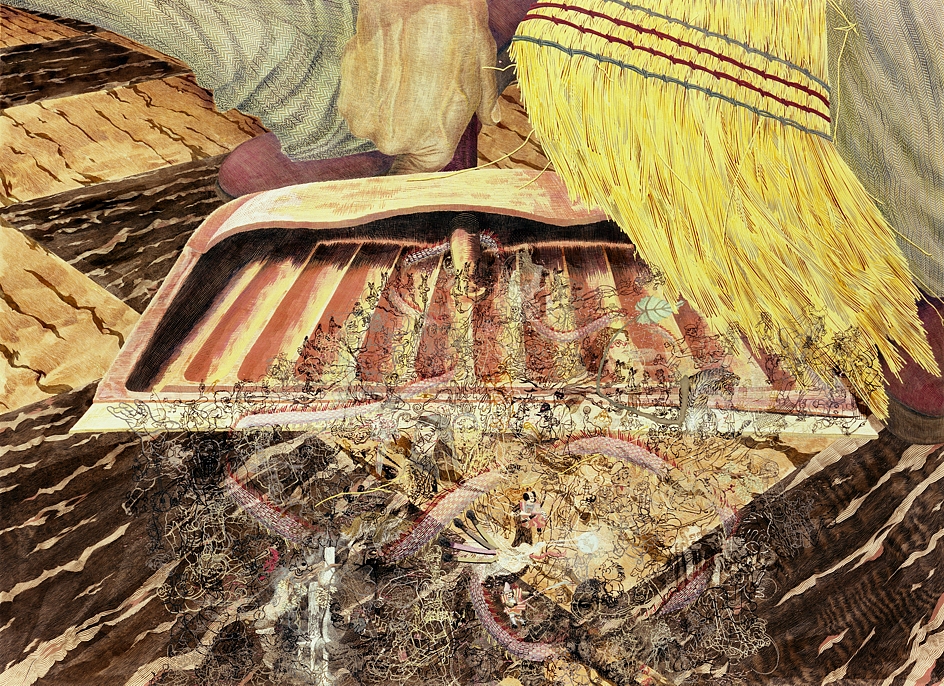
PRIMAL UNION 1975 collection of the artist image area 37 x 27 inches Pelikan colored inks on 40 x 30 inch Strathmore artist's illustration board |
|
On a personal level, this artwork is my homage to the many cartoon characters that captivated me in my youth and inspired my art career. Also included are some mystical personalities and a few real-life flesh-and-blood human beings who also exerted considerable influence on my life choices.
Incidentally, the name of this drawing, Primal Union, and its large basic image elements refer to the 4th and 56th verses of Lao Tsu's 2,600-year-old masterwork Tao Te Ching. Here follow those brief verses, so you may better understand the significance of "The Dustpan," as my friends call this piece. |
|
FOUR The Tao is an empty vessel; it is used, but never filled Oh, unfathomable source of ten thousand things! Blunt the sharpness, Untangle the knot, Soften the glare, Merge with dust. Oh, hidden deep but ever present! I do not know from whence it comes. It is the forefather of the emperors. |
FIFTY-SIX Those who know do not talk. Those who talk do not know. Keep your mouth closed. Guard your senses. Temper your sharpness. Simplify your problems. Mask your brightness. Be at one with the dust of the earth. This is primal union. He who has achieved this state Is unconcerned with friends and enemies, With good and harm, with honor and disgrace. This therefore is the highest state of man. |
|
|
Wait a minute! Observe the enlarged detail below. Is that Wonder Woman in white ink next to the Dragon's head matchstick ears? And Laurel and Hardy and Raggedy Ann below her outstretched arm? And who's that left of her? Bodhidharma? ...the Buddhist philosopher sage who brought kung fu from India to Sumatra, Java, Bali, Malaysia, and eventually China? Why are his eyes so bloodshot? Well, legend has it he cut off his eyelids so he could meditate without falling asleep! And I think I see Pogo Possum inside Bodhidharma's butt! Is that a tiny colorful Samurai bottom center? And is that Betty Boop in pale brown ink just to the right? Looks like Jiminy Cricket and the Katzenjammer Kids above King Kong's head! And I see Elmer Fudd up there near the Marx Brothers. And bottom right I see Felix The Cat in black ink drawn right over the Roadrunner in white ink. The "trick" to viewing this magic artwork is to focus your mind on one ink color only, to the exclusion of all else. Then you'll be able to distinguish a single character from all the undifferentiated "dust" on the floor! Now you should have no problem finding Mighty Mouse and Superman. |
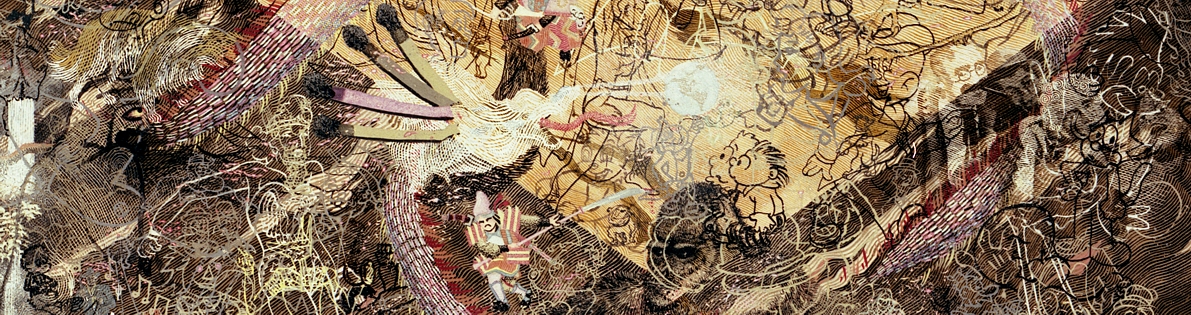 |
| Detail from PRIMAL UNION |
|
|
|
|
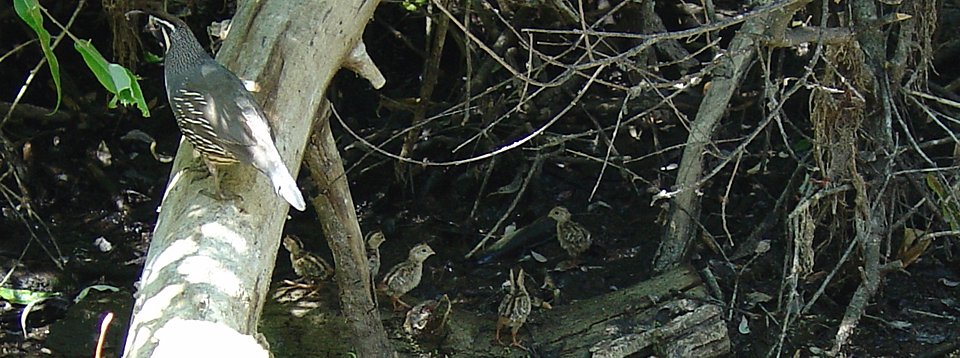
QUAIL RUN © 2003 Keith Halonen
digital photo 21×7¾ in / 53×20 cm PRICELESS |
|
A photograph taken in July 2003. I carry a camera most everywhere I go but I don't take a lot of photos. Some things strike me as one-shot topic-worthy items, something like a political or social cartoon. Nature nearly always impresses but the local wildlife can go beyond the sensational into cross-species emotional territory. The quail are actually calling one another just outside my studio window as I write this. |
|
|
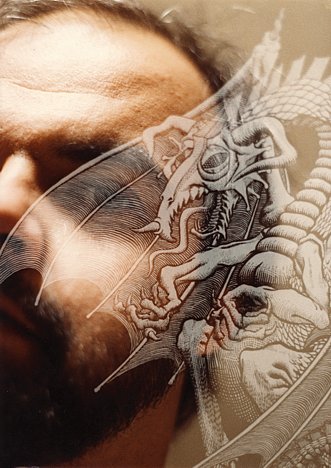
...behind HSIAO KUO FENG
© 1974 © 2002 Keith Halonen SLR double exposure on 35mm film |
|
A double exposure on conventional 35mm film with an old Nikon single lens reflex. The drawing is from my All-Day Coloring Book, 1974, Really Really Really Good Productions, San Mateo, California. After capturing the black and white image on color film, a special button disables the film frame advance mechanism when resetting the shutter release lever. Anything black in the original shot remains available as unexposed film. The next exposure captures the second image in the black areas spared by the first shot. Nowadays, this would be digital photo editing work. Back then, it was just clever forethought. |
|
|
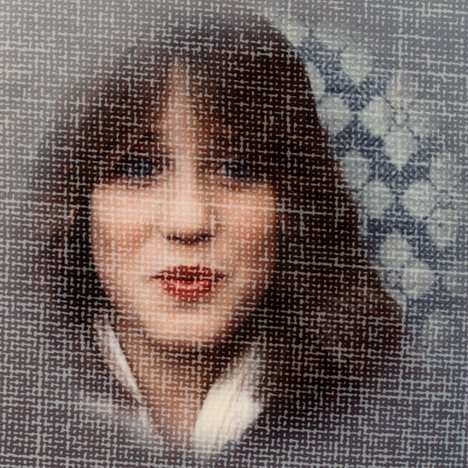
WOVEN ONA © 1983 Keith Halonen SLR double exposure on 35mm film |
|
Another in-camera double-exposure. A black and white fabric pattern was taken from a page in the copyright-free Background Patterns, Textures and Tints, 1976, Dover Publications, New York. Only the white portion of the graphic black and white fabric weave pattern was exposed onto the film. Again, the shutter release lever is reset without advancing the film. A second shot, with an additional lens-mounted circle template, captures the image of the model, exposed onto the areas that remained black in the first shot. |
|
|
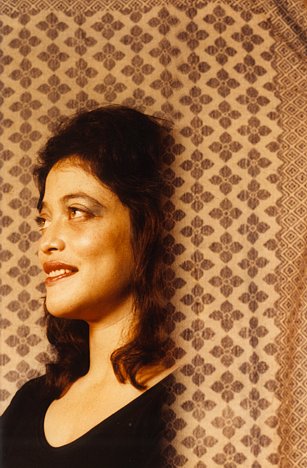
LIGIA FADE © 1983 Keith Halonen SLR double exposure on 35mm film |
|
This one is also an in-camera double-exposure, but this time there's a black card fixed to a jig mounted on the lens. The card is only inches from the lens, while the focus field is farther off near the subject. The card is positioned to block exactly half the lens, dividing it vertically. First the card was set up on the right side so only the left side would be exposed. Because the card is so near, fuzzy focus causes a graduated exposure as light bends around the vertical edge of the black card. After the model steps away from the backdrop, the card is carefully (to avoid moving the camera/tripod) rotated 180° and the second exposure is made. The positioning of the card to intersect the image frame at its centerline is not super-critical, but a reasonable attempt must be made to position it accurately. When the second image overlaps the first, the graduated exposure is moving in the opposite direction and if all has gone well, it should seamlessly overlap the graduated zone on the first image, creating a background pattern that flows across the horizontal field without visible interruption. |
|
|
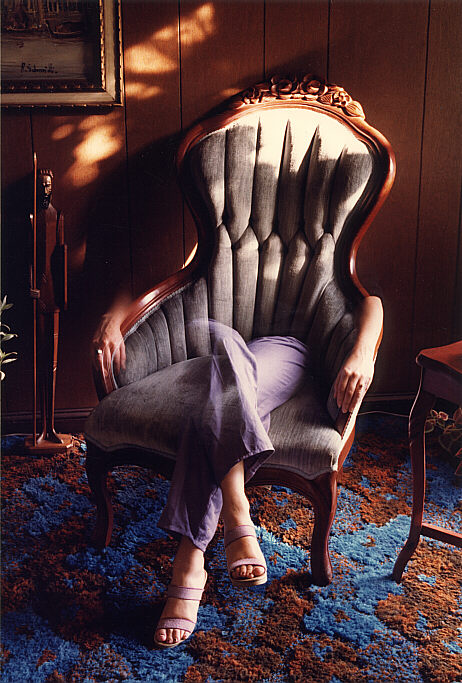
(Let Me Change Into) SOMETHING MORE COMFORTABLE © 1983 Keith Halonen SLR double exposure on 35mm film |
|
Yet one more in-camera double-exposure, my best of genre. Here, the black card was mounted first on the top half of the view frame. After the exposure, the model carefully (to avoid moving it) arose from the chair and I carefully (to avoid moving the camera/tripod) rotated the black card around to block out the bottom half of the frame. Therefore, in this picture, the division is across the horizontal center of the frame. Note that the vertical imagery is seamlessly continuous top to bottom. In the previous example, the card divided left and right sides instead of upper and lower sections.
More pictures to follow as I consider creating a photo gallery. My info pages are back, including my capsule bio. But in strict keeping with Oprah's Book Club tenets, I've rewritten my past a bit. What's the point of having power if you can't abuse it? Master of my own domain! |
|
INFO PAGES A bunch of stuff you never wanted to know and maybe a few things you did... 



|

|
|
by me and some stories about me — all lies! |


|
|
Unless otherwise indicated, entire website contents
— art images, graphic icons, headers, logos, photos, text copy — Copyright © Keith Halonen All Rights Reserved in All Media in The Universe |
|
|
|
|


|